
- 2026-07-22
- Posted by: kimsite
- Categories: Insights, Volume Analysis
Broadening Under Fire: A Spring of Hope Rotation
Buff Pelz Dormeier, CMT®
Kingsview Investment Management | Chief Technical Analyst
Monarch Funds | Index Specialist
The second half of 2026 opens with a market that looks healthy on the surface but is more complicated beneath the surface, and potentially more significant than investors might anticipate. The headline story is easy to understand. After a difficult first quarter, equities staged an impressive second-quarter rebound. The AI trade revived. Semiconductors surged. Mega-cap growth regained its footing. The S&P 500 pushed back toward new highs, and investors who were frightened out of risk earlier in the year were forced to confront a market that refused to stay down.
The rebound itself was not trivial. The S&P 500’s second-quarter gain approached 15%, its strongest quarterly advance in six years, while technology produced an unusually powerful rebound after first-quarter weakness. Yet even that impressive surface strength does not fully explain the market’s message. Strong price recovery is one thing. Durable sponsorship is another.
But the deeper story is more nuanced. This is not simply a continuation of an aging narrow bull market. Nor is it yet a fully confirmed broad-market advance. It is a transition tape. Leadership is rotating. Correlations are collapsing. Dispersion is rising. The market is beginning to reward selectivity again. These conditions may be considered both an opportunity and a warning.
The opportunity could be that the belly of the market is improving. Equal-weighted equities, industrial leadership, dividend-oriented stocks, health care, infrastructure, electrification, data centers, and capital-spending beneficiaries are beginning to participate more meaningfully. The warning is that capital-weighted volume has not yet fully confirmed the advance.
Price has improved faster than sponsorship. In our work, that distinction matters. Price tells us what investors have already done. Volume tells us whether they have done it with conviction. Volume is the fuel of the market. Price can glide for a while on momentum, sentiment, and narrative. But without volume confirmation, the market is flying on thinner air. That is the essential tension heading into the second half. The market has altitude. The question is whether it has enough fuel to maintain and strengthen the climb.
The second half may therefore be less about whether the bull market survives and more about whether it matures. A young bull market can be narrow and speculative. A healthier bull market typically broadens, deepens, and begins to draw support from multiple sectors, factors, and economic themes. A tired bull market, by contrast, often makes new highs on thinner participation while institutions distribute into strength. At the moment, evidence exists for both possibilities. That is why this period deserves discipline, not complacency.
From Recovery to Confirmation
The market’s second-quarter rebound was powerful, but a powerful rebound is not the same thing as a fully confirmed advance. Some of the strongest gains came from areas that had been deeply pressured in the first quarter. Technology, AI, semiconductors, and new economy themes recovered sharply. In several cases, the rebound looked less like a fresh accumulation phase and more like a rapid reversal from oversold conditions, aided by renewed enthusiasm and fear of missing out.
That fear of missing out (FOMO) element should not be underestimated. Many investors missed the 2025 tariff bottom. That was a classic behavioral market event. Fear rose just as capitulation conditions were forming. Price weakness convinced investors that more downside was inevitable, while volume began telling a different story. Those who waited for comfort missed the re-entry. Now, with tariff fears fading, geopolitical tensions easing, and peace-talk headlines improving sentiment, some investors appear to be chasing the recovery they failed to buy last year.
This is understandable. It is also dangerous. A market can move higher on FOMO for a period of time. Momentum attracts capital. Strength forces benchmark-sensitive investors to participate. Underweight managers chase. Retail investors re-engage. But unless that buying is confirmed by stronger upside volume and healthier capital flows, the advance becomes vulnerable to disappointment.
Upside volume in several new economy themes has been relatively light compared with the strength of the price advance. That is an important distinction. A market can look strong when measured by price alone, but if the volume underneath is not expanding, the rally may be driven more by urgency than conviction. In June, technology breadth cooled materially, with few technology-related themes outperforming the S&P 500 during the month, even after an extraordinary second-quarter advance. That does not invalidate the AI theme, but it suggests the easy rebound phase may be giving way to a more selective digestion phase.
In our framework, volume is the fuel. Price is the flight path. A market can glide on narrative, liquidity, and momentum for a while, but without fuel, altitude becomes harder to maintain. That is the key question for the second half: Is this a durable broadening, or merely a FOMO rally wearing the costume of rotation?
The Presidential Cycle: From Frustration to Realization
The presidential cycle provides a useful lens, particularly because 2026 is a midterm year. Midterm years often produce frustration before opportunity. They tend to compress political uncertainty, policy fatigue, and investor impatience into the same window. Investors become impatient. Headlines become louder. Volatility rises. Leadership rotates violently. The first half can feel like a market moving sideways even when important internal work is being done beneath the surface.
Historically, the first half of a midterm year can be choppy, frustrating, and prone to false starts. The second half often carries greater potential for stabilization as markets begin to discount political resolution, policy clarity, and the next phase of the cycle. That does not mean the calendar guarantees strength, but it does mean the market often begins to look through the uncertainty before the headlines become more comfortable.
That description fits 2026 reasonably well. The first half had the feel of the left side of the wave: uncertainty, false starts, overlapping signals, and emotional reversals. Tariff aftershocks, geopolitical concerns, sticky inflation, rate uncertainty, and AI concentration all competed for investor attention. Markets did not lack narratives; they had too many of them.
In 2026, this midterm pattern is complicated by the fact that it is not a typical midterm setup. It is occurring against a backdrop of tariff aftershocks, geopolitical recalibration, a hawkish Federal Reserve, AI capital spending, a still-resilient economy, and investors still emotionally scarred from missing prior entry points. That makes the setup more combustible, but also potentially more rewarding if the second-half handoff broadens.
The second half may begin the right side of the wave. That is where early frustration could turn into realization. Then the market begins looking past the policy noise. Investors start discounting the next phase. Leadership can broaden as capital moves from the obvious winners to the neglected beneficiaries. The opportunity set expands.
However, cycles do not create returns in and of themselves. They create conditions. Confirmation matters. The midterm setup argues for the possibility of a better second-half tone, especially if policy uncertainty begins to fade and the market senses that the worst of the tariff and geopolitical shocks has passed. But the market must still earn that improvement through breadth, volume, and participation.
A presidential-cycle Q4 tailwind without volume confirmation is only a seasonal possibility.
A presidential-cycle tailwind with expanding volume and broader leadership becomes a tradable investment theme.
The Spring of Hope Rotation
The most constructive development heading into the second half is the improvement in the belly of the market. For much of the prior cycle, investors were rewarded for owning the generals: mega-cap technology, AI leaders, and the largest capitalization growth stocks. That leadership was rational. Earnings were superior. Balance sheets were strong. Secular growth was scarce. The market paid a premium for certainty.
But leadership concentration eventually becomes its own risk. When too much capital crowds into the same names for the same reasons, the question shifts from “are these good companies?” to “how much good news is already reflected in price?” Great businesses can become poor trades when expectations outrun sponsorship.
The more encouraging message today is that leadership is beginning to broaden into the middle ranks. Industrials, infrastructure, electrical equipment, construction and engineering, machinery, defense-related capital spending, health care innovation, and dividend-oriented equities are beginning to matter more. This is important because a market led only by AI narratives is inherently more fragile than one supported by physical investment, productivity infrastructure, reshoring, energy systems, health care demand, and broad capital formation.
The composition of leadership matters. A market led only by semiconductors can become fragile. A market led by semiconductors, electrical equipment, construction and engineering, machinery, communications equipment, and infrastructure has a different message. It begins to look less like a one-theme momentum chase and more like a capital formation cycle.
This is what we mean by a Spring of Hope rotation. It is not a declaration that risk has disappeared. It is the recognition that the market may be trying to move from a narrow speculative phase into a broader, more durable leadership structure. The generals are still important, but the troops are beginning to advance. That is how bull markets become healthier.
The phrase “belly of the market” is intentional. The opportunity may not be in the most expensive leaders or the most defensive laggards, but in the broad middle: companies and sectors that were ignored during the narrow AI chase but are now beginning to benefit from capital spending, productivity adoption, supply-chain rebuilding, and a more balanced economy.
For savvy investors, this is where the second half opportunity may reside. Not in abandoning growth. Not in blindly chasing value. But in recognizing that the next phase may reward breadth, quality cyclicality, dividend discipline, and participation from areas that did not lead the prior phase.
The AI Trade: Still Powerful, But No Longer Alone
The AI theme remains real. The capital spending behind AI, data centers, electrical grid demand, power infrastructure, semiconductors, networking, and automation is not imaginary. This is not merely a stock market story; it is an economic investment cycle.
However, the investment implications are changing. The first phase of the AI trade rewarded the most obvious beneficiaries. The second phase may reward the enablers. The third phase may reward the adopters. Markets often begin with narrative concentration and then broaden into practical implementation. That transition can be healthy, but it can also be turbulent because leadership does not pass smoothly from one group to another.
The key risk is that investors continue to treat AI as a single trade when it is becoming a more complex ecosystem. Some AI winners may continue to lead. Others may simply digest prior gains. Some infrastructure beneficiaries may emerge as more durable opportunities than the original high-multiple leaders. Some old economy companies may become new productivity beneficiaries.
This is one reason why selectivity matters. Healthy markets do not need the AI trade to collapse for leadership to rotate. It only needs the AI trade to slow from an unsustainable pace. A pause in the generals can feel uncomfortable for investors who are crowded into them, but it can be healthy if capital rotates into broader participation.
A healthy second-half outcome could be an AI digestion phase rather than an AI breakdown. Under that scenario, mega-cap growth rests, the broader market improves, volume confirms the handoff, and the bull market becomes less dependent on a small group of stocks.
The worst outcome would be a renewed AI chase on weak volume, followed by institutional distribution, failed breadth, and a reversal in the very names investors were forced to buy late. That setup sounds like early Q2. That is why we are watching not only what leads, but how it leads.
The Volume Message: Distribution Has Not Disappeared
The market’s internal improvement should be respected, but it should not be romanticized. Recent volume and capital movements have shown meaningful distribution pressure. Several sessions and weeks in 2026 have produced unusually heavy downside capital-weighted volume and record capital-weighted dollar-volume flows. That suggests large institutional players have used strength to reduce exposure, even as headline indices remained resilient.
Trend of Accumulated Capital Weighted Volume
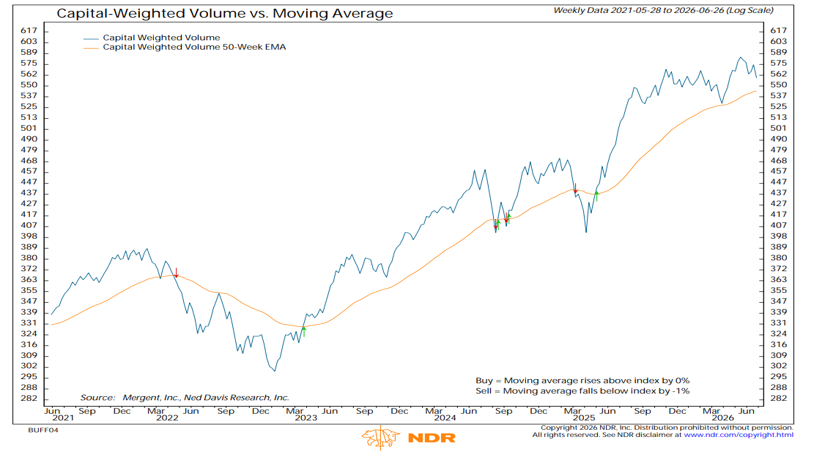
This is one of the most important messages for the second half. Retail investors may buy price. Institutions seek to buy liquidity. When markets rally on enthusiasm, institutions may use that strength to reposition, reduce concentration, or sell into demand. That does not automatically mean a bear market is beginning. But it does mean that the quality of the rally could be tested.
Recent late-June volume analysis captured this tension well. The market was broadening under fire: the broader ranks were showing renewed strength even as capital-weighted volume revealed serious distribution pressure, June 5th registered the highest capital outflows on record, and the last full week of June registered the largest downside capital-weighted volume since August 2024, record weekly capital-weighted dollar volume, and new all-time record outflows. In other words, while parts of the market were improving, significant institutional capital appeared to be selling into strength.
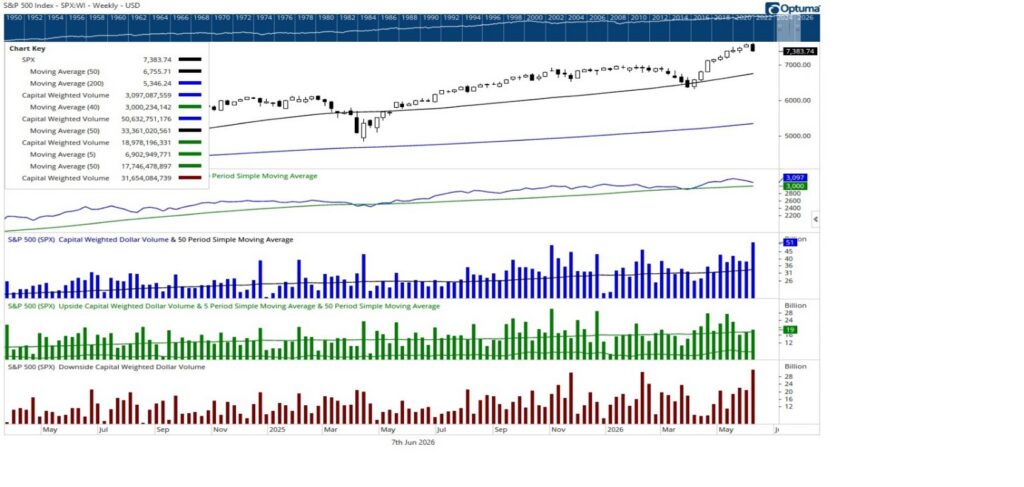
That is not an outright bearish conclusion. It is a discipline signal. A healthy market can absorb institutional selling if new sponsorship emerges elsewhere. A fragile market cannot.
The good news is that broader participation has improved. The advance-decline structure has firmed. Equal-weighted performance has shown life. Dividend stocks and the middle ranks have participated. That is the hopeful side of the ledger.
NYSE Accumulated Advance- Decline Line
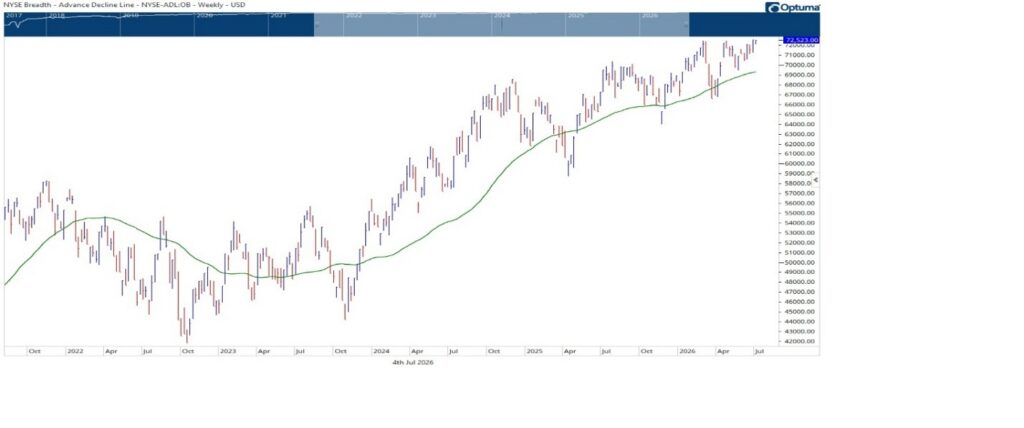
The caution is that capital-weighted volume has not yet delivered an all-clear. Heavy downside volume and record outflows are not background noise. They are evidence that liquidity is being redistributed beneath the surface.
The second half will likely be decided by whether that redistribution is constructive or defensive. Constructive redistribution would mean capital moving out of crowded mega-cap leadership and into broader sectors with improving trends. Defensive redistribution would mean institutions quietly reducing exposure while retail and benchmark-sensitive buyers chase price higher. The tape will tell us which one is occurring.
S&P 500 short-term support resides at 7250, intermediate support 7000, and major rests at 6100. The generals (QQQ’s Invesco QQQ Trust ETF) may find short-term support at 685, intermediate at 655, and major at 600 to 575. Troops (IWM iShares Russell 2000 ETF) have supply line set up at 275, 250, and 230.
Macro: Resilient, But Not Easy
The macro backdrop remains supportive enough to keep recession risk contained, but not easy enough to justify complacency.
The economy continues to show resilience. Demand has not collapsed. Labor conditions remain firm enough. Financial conditions are still relatively loose. Corporate activity tied to infrastructure, automation, and productivity investment remains meaningful. These are not the typical ingredients of an imminent recession.
At the same time, inflation remains sticky, and the Fed does not appear ready to pivot toward aggressive easing. The market has repeatedly hoped for a more accommodative monetary backdrop, but the economy’s resilience and persistent inflation pressures have kept policymakers cautious. That means the second half may not enjoy the simple liquidity tailwind investors often associate with broad rallies.
This matters because valuation and volume become more important when liquidity is not abundant. When money is easy, markets can tolerate more speculation. When policy is restrictive or uncertain, investors eventually demand confirmation from earnings, cash flow, breadth, and volume. The second half of 2026 may be less forgiving of concept stocks and more rewarding to companies with visible demand, operating leverage, capital discipline, and shareholder return. That would fit the broadening theme. It would also fit a market transitioning from speculative recovery to fundamental confirmation.
The 2000 Echo: Similar, But Not the Same
There are late-cycle echoes that should not be ignored. Valuations are elevated. Technology concentration is historically high. Margin debt has risen. Equity issuance has picked up. Investors are again captivated by a transformational technology theme. These similarities to prior speculative periods deserve respect.
More specifically, the warning signs are the familiar ones: stretched valuations, rising equity issuance, increasing margin debt, and historically high technology concentration. None of these alone is sufficient to end a bull market. But together, they raise the cost of being complacent. They tell us that the market is maturing, that expectations have risen, and that liquidity must work harder to keep the advance intact.
But similarity is not destiny. Today’s backdrop is not a perfect replay of the dot-com era. Corporate fundamentals are stronger. Many leading technology companies generate significant cash flow. Capital spending relative to cash flow is not as reckless as it was in the late 1990s. Consumer sentiment is not broadly euphoric. The market has pockets of speculation, but it also has areas of skepticism, neglect, and reasonable valuation.
That makes the current environment more subtle than a simple bubble call. The risk is not necessarily that the market collapses like 2000. The more probable risk is that the most crowded leadership begins to underperform while capital rotates elsewhere. That would feel like a major change to investors whose portfolios are built around yesterday’s winners, even if the broad market remains intact.
This is why investors should consider thinking in terms of leadership risk, not just market risk. An index can remain near highs while the leadership underneath changes dramatically. Portfolios can underperform in a bull market if they are positioned for the prior phase rather than the next one. The second half may reward those who recognize the handoff early.
A Market of Dispersion, Not Simplicity
One of the defining features of this market is dispersion. Sector leadership has been changing quickly. Stock correlations have fallen. Themes that led in one month have lagged the next. Defensive areas have periodically strengthened, then cyclicals have reasserted themselves. Technology has surged, cooled, and rotated internally. Industrials have quietly led. Health care has improved. Consumer discretionary has become more uneven. This is not a passive beta environment in the traditional sense. It is a market where the index may hide more than it reveals.
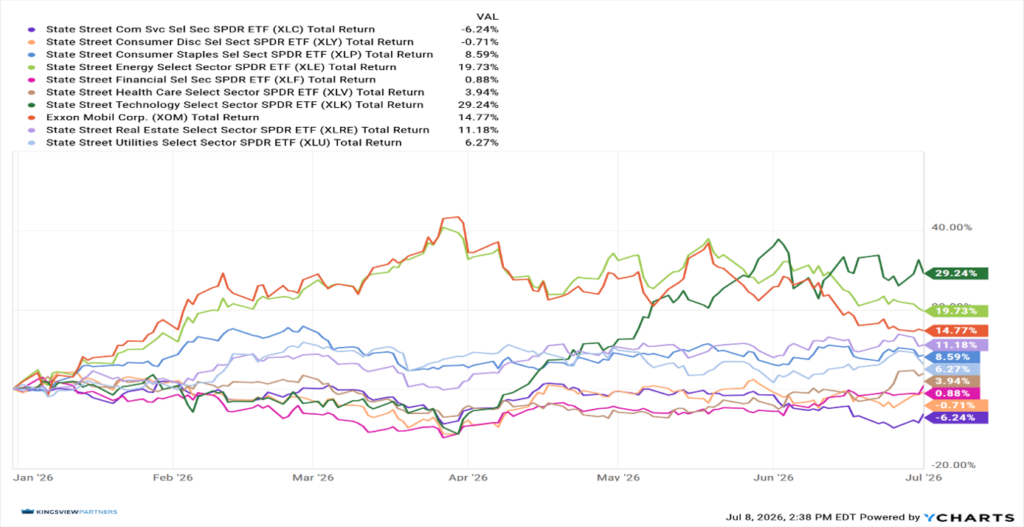
Low correlation means opportunity for active selection, but it also means fewer investors are experiencing the same market. One portfolio may feel like a bull market. Another may feel like a correction. One advisor may be fielding client questions about missing AI upside, while another is explaining why dividend and equal-weight strategies are quietly improving.
That dispersion is exactly why the second half requires a more refined message. The conversation should not just be, “Are we bullish or bearish?” The better conversation might consider, “Where is participation improving, where is volume confirming, and where is price running ahead of sponsorship?” That is a more sophisticated framework for this environment.
Three Second-Half Paths
The second half of 2026 may follow more than one path.
1. The Healthy Broadening Path
In the constructive scenario, the Spring of Hope rotation continues. The belly of the market strengthens. Equal-weight participation improves. Industrials, health care, infrastructure, dividend equities, and select cyclicals attract capital. AI leadership digests rather than breaks. Volume begins to confirm price. Institutional flows stabilize. The advance-decline structure remains firm.
This would be the healthiest outcome. It would suggest that the market is transitioning from a narrow leadership phase into a broader, more durable advance. Under this path, pullbacks would likely be opportunities, provided volume remains constructive.
2. The FOMO Without Fuel Path
In the more fragile scenario, investors continue to chase the most obvious winners because they missed earlier entry points. AI, semiconductors, high beta, and speculative growth regain leadership, but upside volume remains light. Capital-weighted flows fail to confirm. Institutions continue to sell into strength. Margin activity rises. Retail enthusiasm increases.
This path can still produce higher prices, but it becomes increasingly unstable. The market would be advancing, but with less fuel. In that environment, the risk is not necessarily immediate downside, but sudden air pockets when the narrative is challenged.
3. The Distribution Overwhelms Rotation Path
In the adverse scenario, heavy downside volume and institutional outflows prove to be early warnings. Breadth weakens. The advance-decline line rolls over. Equal-weight leadership fades. The belly of the market loses sponsorship. Mega-cap technology can no longer carry the index. Policy or earnings disappointments expose the lack of confirmation.
This would call for a more defensive posture. Not because price alone failed, but because the internal sponsorship behind price deteriorated.
At present, the evidence may not demand alarm. But it does demand respect.
Portfolio Implications for Investors
For equity investors, the second-half message considers balanced participation, but verify. The broadening of leadership argues against being overly defensive. The improvement in the belly of the market suggests opportunity beyond the crowded winners. The presidential-cycle setup may support a better tone as the year progresses into Q4. The economy remains resilient enough to sustain earnings. The market’s internal rotation may be healthier than the headline concentration suggests.
At the same time, heavy downside volume, institutional distribution, rising leverage, and elevated concentration argue against chasing indiscriminately. Investors should not confuse price recovery with full confirmation.
The practical implications are straightforward. First, maintain exposure in the bull markets, but contemplate broadening the lens. The second half may reward portfolios that are less dependent on mega-cap growth and more exposed to quality participation across industrials, infrastructure, health care, dividend growth, and select cyclical beneficiaries.
Second, consider volume as your referee. Price breakouts that are confirmed by expanding upside volume and improving capital flows deserve more trust. Price breakouts on light volume, especially in crowded themes, deserve skepticism.
Third, treat AI as an ecosystem, not a single trade. The next opportunities may come from infrastructure, power, grid, data centers, automation, and productivity adoption rather than only from the original market darlings.
Fourth, respect dispersion. This is a market where sector, factor, and theme selection may matter more than broad index exposure alone.
Finally, avoid emotional re-entry. Investors who missed the 2025 tariff bottom may be tempted to chase every peace-talk rally, AI breakout, or new high. Our discipline allows volume to determine whether enthusiasm has real sponsorship.
Conclusion: Measured Hope
The second half of 2026 begins with genuine promise of reward as well as risk. The market has survived a difficult first half. Leadership is broadening. The belly of the market is improving. The economy remains resilient. The presidential-cycle backdrop may become more favorable as uncertainty begins to clear. There is a credible path toward a healthier, broader bull market.
But hope is not a process. Confirmation is. The market is giving us a more optimistic message than it did earlier in the year, but not an unconditional one. The Spring of Hope rotation is real enough to respect. It is not yet confirmed enough to chase blindly. The generals are no longer the only story. The troops are beginning to move. The supply lines, however, now need repair.
For investors, the second half may not be about being bullish or bearish in the abstract. It may be more about recognizing whether the market is broadening with sponsorship or rising on FOMO. That distinction will likely determine whether 2026 becomes a year of durable rotation or another lesson in chasing price without volume. Remember, price is the market testimony; volume is the polygraph.
IMPORTANT DISCLOSURES
Kingsview Wealth Management (“KWM”) is an investment adviser registered with the Securities and Exchange Commission (“SEC”). Information presented is for educational purposes only and does not intend to make an offer or solicitation for the sale or purchase of any specific securities, investments, or investment strategies. Investments involve risk and unless otherwise stated, are not guaranteed.
This material has been prepared by Kingsview Wealth Management, LLC. It is not, and should not, be regarded as investment advice or as a recommendation regarding any particular security or course of action. Opinions expressed herein are current opinions as of the date appearing in this material only. All investments entail risks. There is no guarantee that investment strategies will achieve the desired results under all market conditions and each investor should evaluate their ability to invest for the long term. This information does not address individual situations and should not be construed or viewed as any type of individual or group recommendation. Be sure to first consult with a qualified financial adviser, tax professional, and/or legal counsel before implementing any securities, investments, or investment strategies discussed.
PAST PERFORMANCE IS NO GUARANTEE OF FUTURE RESULTS