
Portfolio Manager Insights | Housing Market Update: Impact on the Economy and Financial Plans - 4.22.26
Click here to download this commentary in PDF format.
For many households, a home represents not only where they live and raise their family, but also their largest financial asset, monthly expense, and source of debt. From a broader economic perspective, the housing market is deeply intertwined with consumer confidence and economic growth. So, while investor attention has been on geopolitics and market volatility this year, the fact that home prices remain near all-time highs continues to play an important role in financial planning.
Housing activity is mixed but prices remain near record levels
Housing activity has been mixed in recent years across a number of measures. For new buyers, the biggest challenge with affordability is mortgage rates. The 30-year fixed mortgage rate is around 6.3%, well above the lows of 3% or less in 2020 and 2021, and the average of 4.6% since 2008. This means that the monthly cost of purchasing a home is significantly higher than it was just a few years ago, even for buyers with substantial down payments.
For those homeowners who were able to lock in mortgage rates near historic lows over the past decade, it can be a difficult decision to sell and give up these rates. This has kept the supply of existing homes limited, leading to a tighter housing market. In March, the sales volume of existing homes fell 3.6%, a reversal to its low one year ago, after climbing earlier this year.
In reaction to this, new construction has increased, with housing starts accelerating to 1.5 million units per year in January, but it will take time for this to ease pressure on prices. Even among homebuilders, however, the outlook remains uncertain. The NAHB/Wells Fargo Housing Market Index, which measures sentiment among homebuilders, fell from 38 to 34 in April. From a stock market perspective, the homebuilding subindustry within the S&P 500 index has been roughly flat on the year with a gain of only 0.4%, after several years of mixed performance.
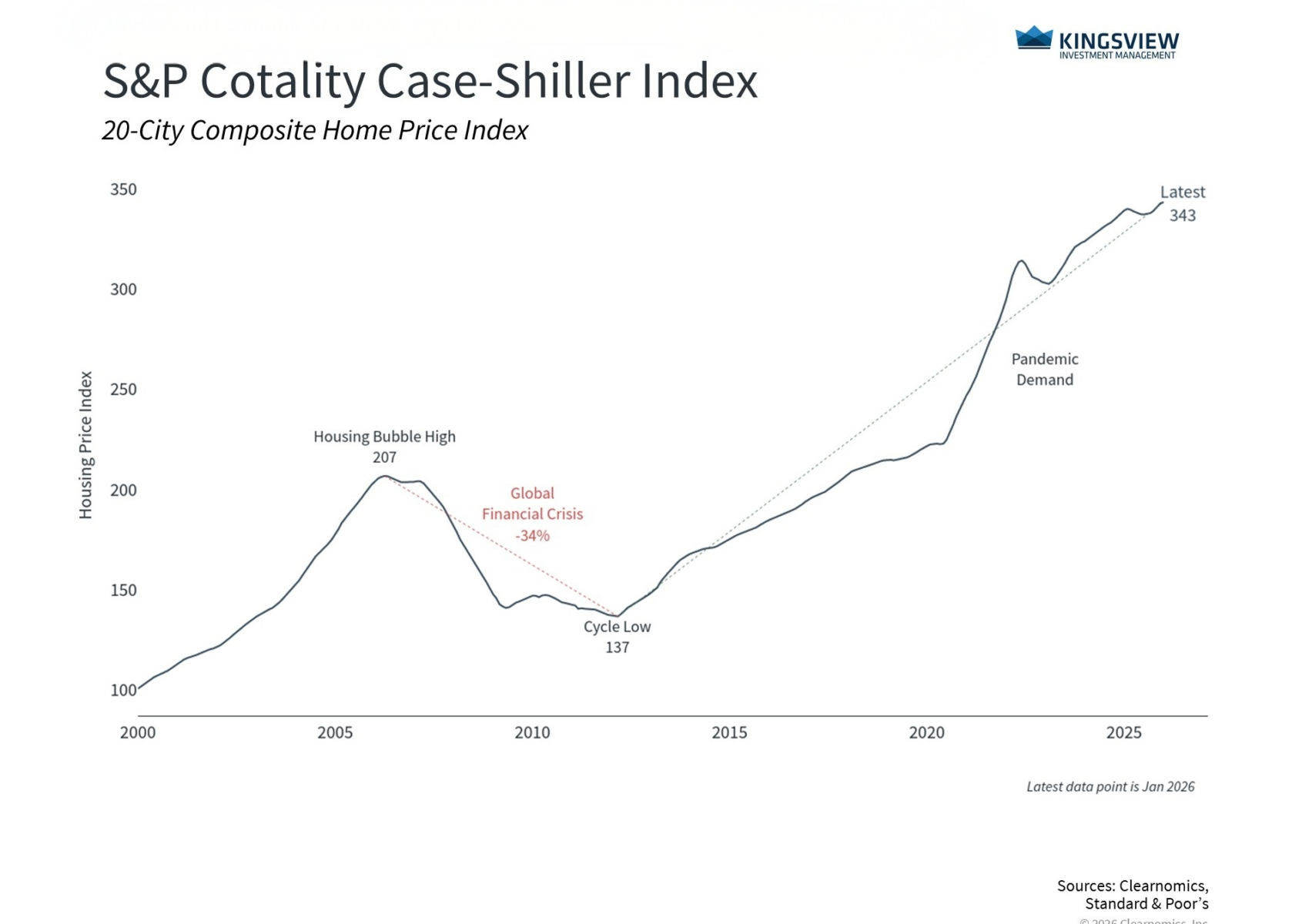
Despite these challenges with housing activity, home prices are still near record levels across the country. The S&P Cotality Case-Shiller indices, which measure prices nationally and across the largest U.S. cities, have climbed steadily. Across the country, home prices have experienced significant declines in only two periods in recent history: the 2008 housing bust and the brief pullback that followed the rapid rise in inflation beginning in 2022.
Higher home prices mean that, from a macroeconomic perspective, balance sheets for homeowners have generally remained healthy. This has been further supported by a low unemployment rate and strong wage gains, and are important reasons that overall consumer spending has held up better than many feared. These factors have helped to offset poor consumer sentiment driven by inflation and job losses in certain sectors, such as in tech.
Housing is often the foundation of wealth across generations
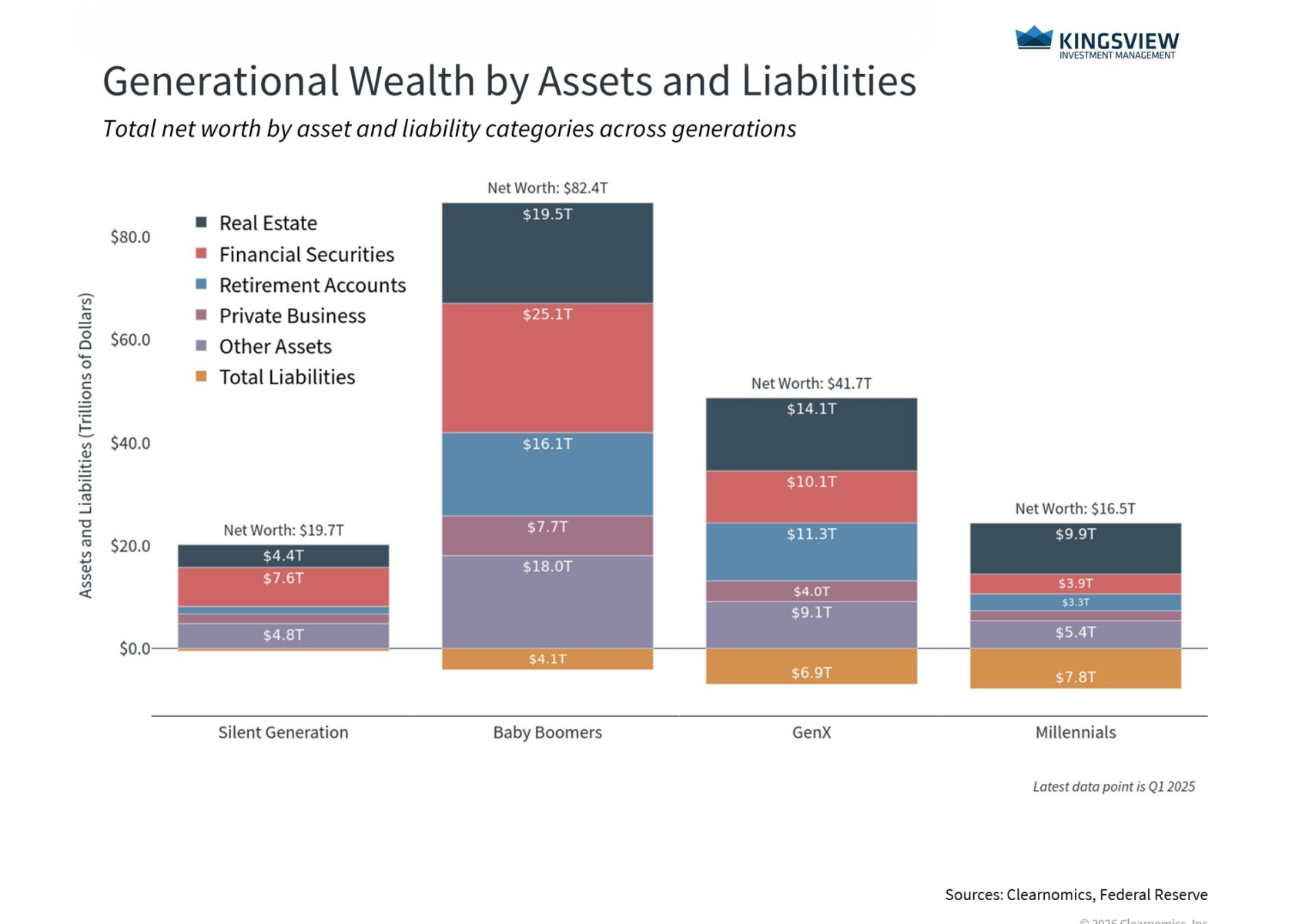
As the chart above illustrates, real estate is an important component of household net worth across all generations. For older Americans, real estate holdings often represent a significant share of total assets accumulated over decades. Baby Boomers, for instance, hold over $19.5 trillion in real estate, representing roughly 24% of their total net worth. For Gen X and Millennials, that share rises to approximately 34% and 60%, respectively. Of course, real estate is also a significant source of outstanding debt for younger households that have not had time to pay off their mortgages or benefit from decades of housing market growth.
This “wealth effect” is important, especially when the stock market is volatile and the world feels uncertain. When home values rise, homeowners tend to feel more financially secure and may be more willing to spend on goods and services, supporting broader economic growth. They may feel this way even if they do not actively access their home equity, such as through a reverse mortgage or home equity line of credit.
This also highlights the importance of maintaining a holistic perspective around financial planning. This is because short-term stock market swings, while never pleasant, may be less impactful to an investor’s financial picture than they may perceive, since much of their wealth is tied to other assets. In fact, depending on the investor’s specific situation, prioritizing mortgages and other forms of debt may be more helpful than focusing on the stock market.
These psychological and financial effects make the housing market important as both an economic indicator and when it comes to financial planning. Inflation is another factor that is affected by housing costs, since it is the primary driver of the “shelter” category within the Consumer Price Index. Even before energy prices led to the latest jump in headline inflation, elevated shelter costs were an important reason that inflation has been slower to return to the Fed’s 2% target.
Household debt levels reflect both mortgage and consumer borrowing
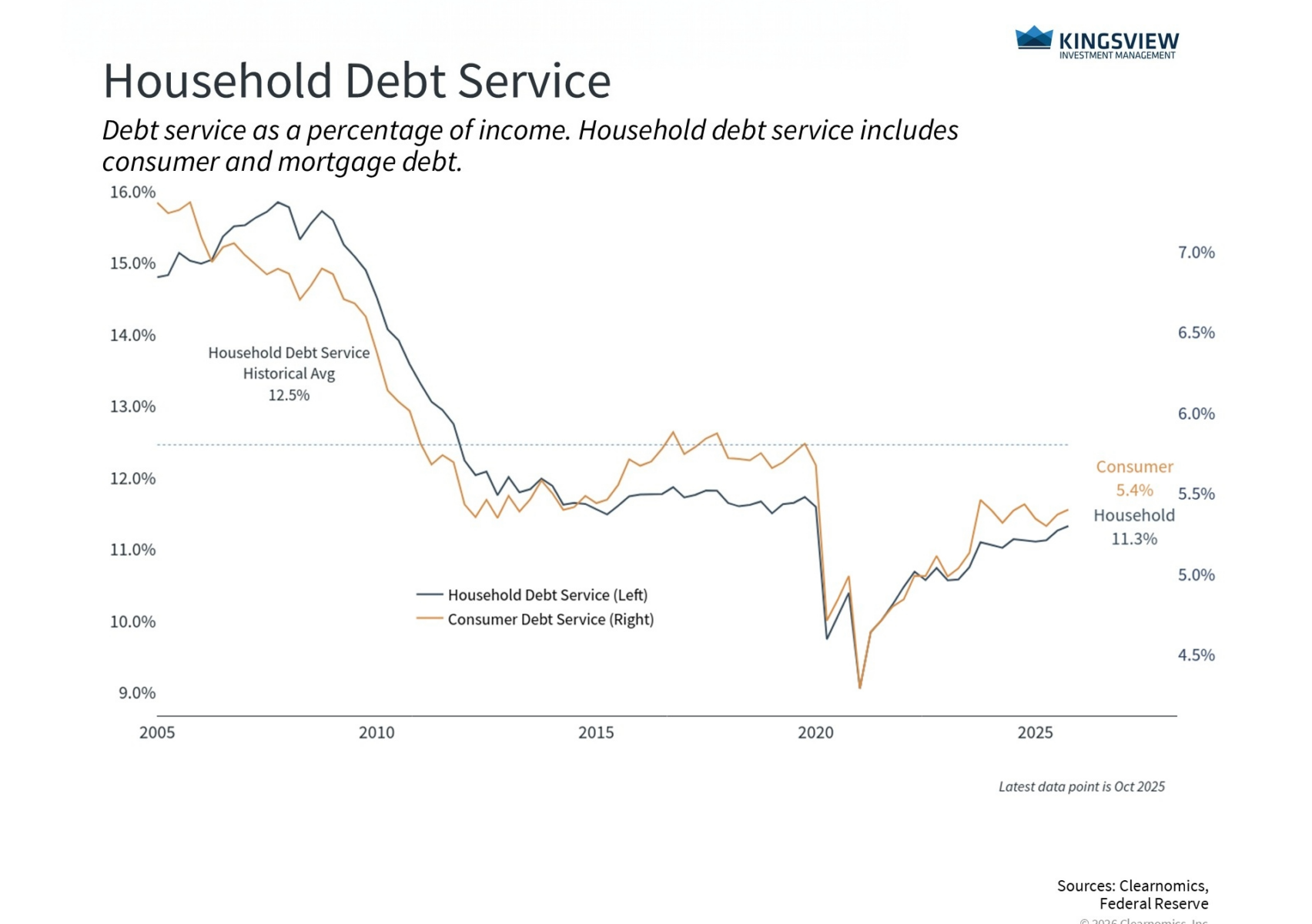
Of course, housing is not only the largest asset on most household balance sheets, but also the largest source of debt. The accompanying chart shows both household debt, which includes mortgages, and consumer debt, which does not. Even as other forms of debt rise, including credit cards and student loans, mortgage debt represents by far the largest component of total household borrowing.
One encouraging aspect of today’s environment is that debt service levels (the size of debt payments relative to household income) are still moderate relative to history. Mortgage underwriting standards have also been considerably more conservative since the 2008 financial crisis, when household debt levels were far higher. Still, the burden of these debt payments is a real consideration for many households, particularly those who purchased homes in recent years at higher prices and interest rates.
So, from an economic perspective, healthy home prices could continue to support consumer balance sheets and the broader economy despite mixed activity. From a financial planning perspective, it’s important for investors to have a clear understanding of their full financial picture. While headlines have focused on stock market swings and the Middle East conflict, the truth is that focusing on aspects of our financial plans closer to home may play a much larger role in achieving long-term goals.
The bottom line? The housing market remains a core part of both household finances and the broader economy. With ongoing market volatility, understanding the key drivers of household wealth can help investors maintain perspective and stay focused on their long-term financial plans.
Historical references do not assume that any prior market behavior will be duplicated. Past performance does not indicate future results. This material has been prepared by Kingsview Wealth Management, LLC. It is not, and should not, be regarded as investment advice or as a recommendation regarding any particular security or course of action. Opinions expressed herein are current opinions as of the date appearing in this material only. All investments entail risks. There is no guarantee that investment strategies will achieve the desired results under all market conditions and each investor should evaluate their ability to invest for the long term. Investment advisory services offered through Kingsview Wealth Management, LLC (“KWM”), an SEC Registered Investment Adviser. (2025)
The illustrations, charts, and other visual materials included in this marketing material are provided by third-party sources. These illustrations are for informational purposes only and do not represent the actual performance of any specific investment, product, or strategy. The third-party information presented herein has been obtained from sources believed to be reliable; however, Kingsview Wealth Management makes no warranty or representation, expressed or implied, as to its accuracy or completeness. The inclusion of this material does not imply an endorsement of any third-party content, nor should it be construed as financial advice.