
Minute Market Update: 4.4.25
Click here to download this commentary in PDF format.
The Trump administration officially announced its “reciprocal” tariffs on the afternoon of April 2nd, sparking a major global market sell-off. On Thursday, many individual stocks and their respective indices experienced their worst trading day since 2020. Wednesday’s sweeping tariffs represent the latest chapter in President Trump’s “America First” trade agenda, signaling a renewed push to reduce imports and stimulate domestic production.
Just a few weeks ago, President Trump’s decision to delay tariffs on several key trade partners gave investors hope that diplomatic resolutions might avert widespread levies. As we noted in our previous Minute Market Update on March 5th, the tariffs during Trump’s first term helped accelerate new trade agreements seen as more favorable to the U.S. — which has become a focus point once again. Still, investor sentiment remains fragile, and markets have responded nervously to what is a rapidly evolving situation.
Understanding Tariffs: Who Pays and Why They Matter
Simply put, tariffs are taxes imposed on specific imports with the intention of making domestically produced alternatives more attractive. Initially, the importing company pays the tariff as a tax to the domestic government. Depending on the demand for the affected product, those costs are either passed on to consumers via higher prices or absorbed by the company — often reducing margins.
In theory, tariffs are meant to discourage reliance on foreign goods and encourage domestic contribution, which can create jobs, reduce trade deficits, and boost economic activity. However, they are often viewed negatively due to the potential for reduced global growth and the risk of triggering retaliatory trade wars. A historical example is the Smoot-Hawley Tariff Act of the late 1920s, which contributed to a decline in global trade and a rise in protectionism.
While potential for a “global trade war” may seem high right now, it is important to retain a longer-term perspective. It is only natural for other countries to review and possibly adjust their trade policies in the coming days. Foreign leadership announcing new retaliatory tariffs in response to recent developments, led by China just this morning (April 4th), should be expected, given the U.S. position as a significant player in global trade.
A Globalized World Makes Tariffs More Complex
Assessing the impact of tariffs today is far more complicated than it was a century ago. Supply chains now span continents, and modern production often involves multiple countries. For instance, many U.S. companies outsource manufacturing to countries with lower labor costs, resulting in lower consumer prices and higher corporate margins.
The U.S. economy is largely service based, with much of its manufacturing outsourced over the past several decades. This trend has contributed to the country’s persistent trade deficit — an issue President Trump aims to address through tariffs and efforts to rebalance the federal budget.
While globalization has its downsides, it has been the dominant economic policy for the U.S. since World War II, fueling capitalism and enabling American companies to become global giants. This has led to the U.S. importing far more than it exports — but not all aspects of the trade deficit are inherently negative.
The U.S. dollar, for instance, is arguably America’s most important export. Its strength and global demand reflect the country’s attractiveness to investors and foreign governments. This has fueled high consumer spending and robust economic growth — albeit at the cost of a growing trade imbalance.
The Path Forward: Uncertain but Potentially Opportunistic
President Trump has made it clear that the goal is to reduce the trade deficit and restore U.S. competitiveness in manufacturing. Whether the tariffs will succeed in that goal remains to be seen and may take years to fully evaluate. As the situation continues to evolve, some countries may negotiate new agreements that lead to the removal of tariffs, while others may see production shift back to the U.S.
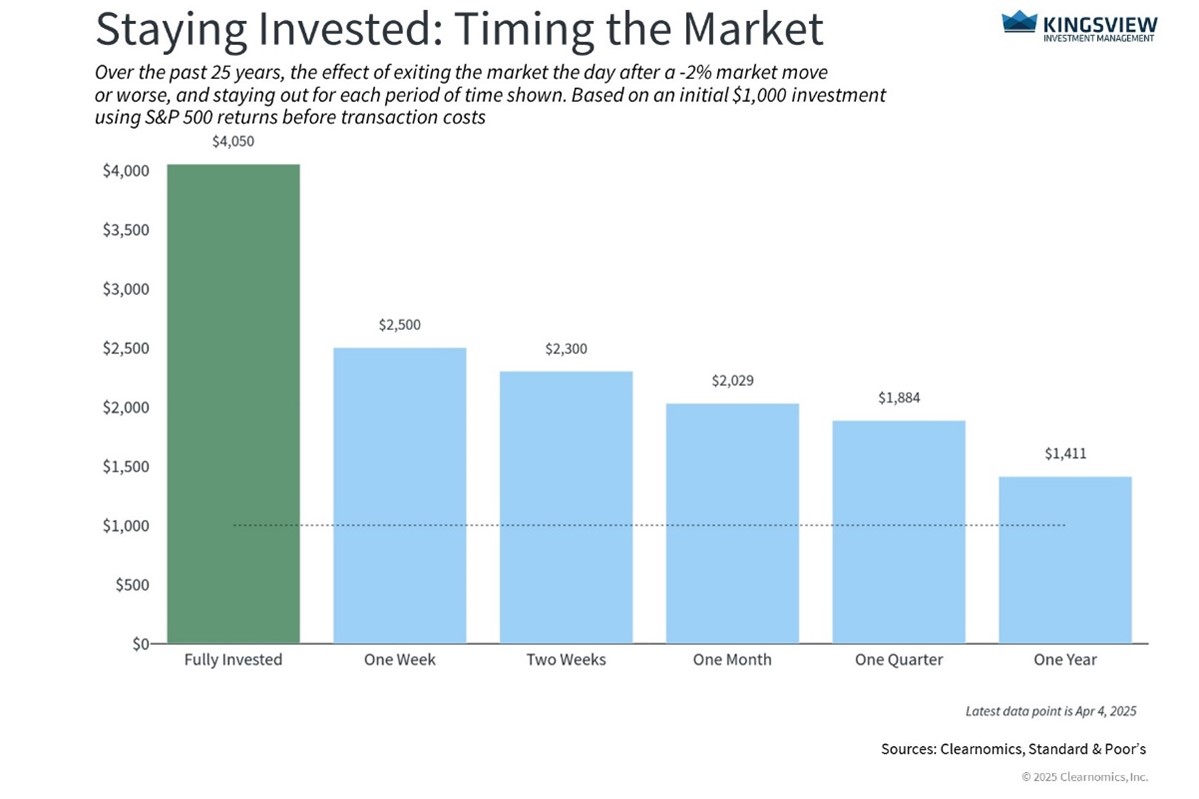
In times like these, it is critical to remember the concept of “headline risk” — the idea that reacting to short-term news can jeopardize long-term investment outcomes. Emotional decisions made during volatile periods may lead to missed opportunities. Historically, the most attractive moments to invest have tended to be those that feel the most uncertain.
Markets often appear “scary” when opportunity is greatest, and “safe” when risk is just around the corner. As investment managers, our role is to help filter out noise, maintain discipline, and make thoughtful decisions on behalf of our clients. In our view, the recent market sell-off appears overdone for what we know today. As negotiations progress, we believe the market may find its footing, thus presenting attractive buying opportunities for long-term investors.
Kingsview Wealth Management (“KWM”) is an investment adviser registered with the Securities and Exchange Commission (“SEC”). Information presented is for educational purposes only and does not intend to make an offer or solicitation for the sale or purchase of any specific securities, investments, or investment strategies. Investments involve risk and unless otherwise stated, are not guaranteed.
This material has been prepared by Kingsview Wealth Management, LLC. It is not, and should not, be regarded as investment advice or as a recommendation regarding any particular security or course of action. Opinions expressed herein are current opinions as of the date appearing in this material only. All investments entail risks. There is no guarantee that investment strategies will achieve the desired results under all market conditions and each investor should evaluate their ability to invest for the long term.
This information does not address individual situations and should not be construed or viewed as any typed of individual or gr oup recommendation. Be sure to first consult with a qualified financial adviser, tax professional, and/or legal counsel before implementing any securities, investments, or investment strategies discussed. Any performance shown since inception is based upon composite results of the stated portfolio. Portfolio performance is the result of the application of the KIM Volume Factor Global Unconstrained investment process. It does not reflect any investor’s actual experience with owning, trading or managing an actual investment account.